33
AI &AUTOMATION BAROMETER REPORT
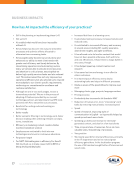
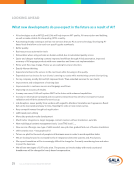
• It will only continue the revolution of NMT and other Machine Translation solutions, leading to bringing
more value to creative translation work as opposed to technical translation. It may however make
companies less reluctant to adding more languages, making some languages more visible online.
• It’s going to change everything.
• Language, content and data specialists and curators
• LLMs will replace finally NMT. Specialized LLM or trained models will emerge for all applicable areas:
translation, LQA, terminology extraction, alignment, content creation...
• New role of the translator as linguistic consultant, new services
• Not absolutely sure about it yet. We’ll have to see if all the new tech will play out, prove to be useful,
increase efficiency... Above all when considering total cost of ownership. Also not sure if solutions
can be found to overcome the current limitations of LLM, transformers etc. And the impact also
depends on how fast companies will be developing new tools and get rid of old limiting tech such as
TM, segmentation etc.
• Not sure how exactly it will impact the localization industry, but certain that the future localization
industry will be very different from what we know now. For one thing, human translation will become
almost extinct with people needing to edit auto-generated translations only in special cases. New
services will need to take its place, but it seems there will be a shift from a need for linguistic
expertise to a need for technical (IT) expertise.
• Not sure yet as there is lot of information out there but nothing firm regarding how this will impact
LSP
• Our clients will demand more, better, cheaper, faster. We will adapt our services and processes to
incorporate AI-enhanced solutions.
• reduce the need for translators, but increase the need for revision, role changing, and billing.
• The actual basic translation may be taken over by AI algorithms. Humans may be necessary to train,
overlook and QA the output from AI algorithms -for the first 5 years. After that, I doubt if humans
would still be necessary for the task.
• Very strong impact
• We think it will increase opportunities to provide AI-assisted services added to the existing capacity
to produce more human crafted outputs when still required.
• Yes, certainly it will. AI is not new in our sector as Neural Machine Translation is already here. AI
will impact the future of ANY organization that, like ours, provides professional services to their
customers.
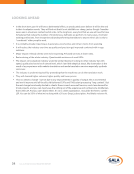
Negative
• Cautious
• Complete rethink on every aspect of the industry. Ever-increasing uncertainty levels and difficulty
luring new talent amidst this uncertainty. Gap between Global South and North increasing.
• Definitely, the number of easy jobs will decrease and only the complex tasks will be outsourced to
LSPs. So, the number of LSPs will also be lower.
LOOKING AHEAD
AI &AUTOMATION BAROMETER REPORT
• It will only continue the revolution of NMT and other Machine Translation solutions, leading to bringing
more value to creative translation work as opposed to technical translation. It may however make
companies less reluctant to adding more languages, making some languages more visible online.
• It’s going to change everything.
• Language, content and data specialists and curators
• LLMs will replace finally NMT. Specialized LLM or trained models will emerge for all applicable areas:
translation, LQA, terminology extraction, alignment, content creation...
• New role of the translator as linguistic consultant, new services
• Not absolutely sure about it yet. We’ll have to see if all the new tech will play out, prove to be useful,
increase efficiency... Above all when considering total cost of ownership. Also not sure if solutions
can be found to overcome the current limitations of LLM, transformers etc. And the impact also
depends on how fast companies will be developing new tools and get rid of old limiting tech such as
TM, segmentation etc.
• Not sure how exactly it will impact the localization industry, but certain that the future localization
industry will be very different from what we know now. For one thing, human translation will become
almost extinct with people needing to edit auto-generated translations only in special cases. New
services will need to take its place, but it seems there will be a shift from a need for linguistic
expertise to a need for technical (IT) expertise.
• Not sure yet as there is lot of information out there but nothing firm regarding how this will impact
LSP
• Our clients will demand more, better, cheaper, faster. We will adapt our services and processes to
incorporate AI-enhanced solutions.
• reduce the need for translators, but increase the need for revision, role changing, and billing.
• The actual basic translation may be taken over by AI algorithms. Humans may be necessary to train,
overlook and QA the output from AI algorithms -for the first 5 years. After that, I doubt if humans
would still be necessary for the task.
• Very strong impact
• We think it will increase opportunities to provide AI-assisted services added to the existing capacity
to produce more human crafted outputs when still required.
• Yes, certainly it will. AI is not new in our sector as Neural Machine Translation is already here. AI
will impact the future of ANY organization that, like ours, provides professional services to their
customers.
Negative
• Cautious
• Complete rethink on every aspect of the industry. Ever-increasing uncertainty levels and difficulty
luring new talent amidst this uncertainty. Gap between Global South and North increasing.
• Definitely, the number of easy jobs will decrease and only the complex tasks will be outsourced to
LSPs. So, the number of LSPs will also be lower.
LOOKING AHEAD